



A new single tax class
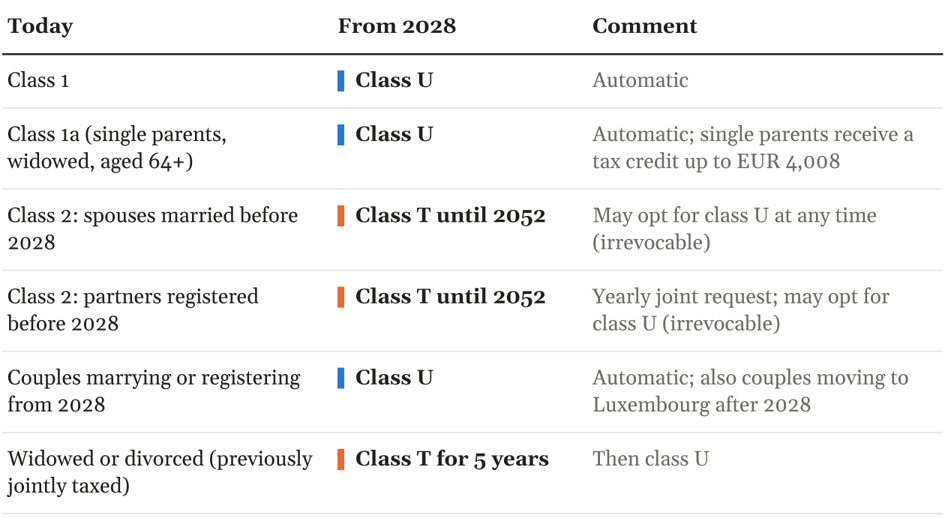
From 2028, classes 1 (single taxpayers) and 1a (single parents, widowed taxpayers, and taxpayers aged 64 and over) will be replaced by a single tax class, commonly referred to as tax class U. It will also apply automatically to couples marrying or registering a partnership from 2028. Class 2 (married spouses or registered partners) will survive only as a transitional tax class T for existing couples.
Under the new tax class U, each taxpayer is taxed individually on their own income. For married couples and registered partners, income and deductions are allocated to the spouse or partner who earns or bears them.
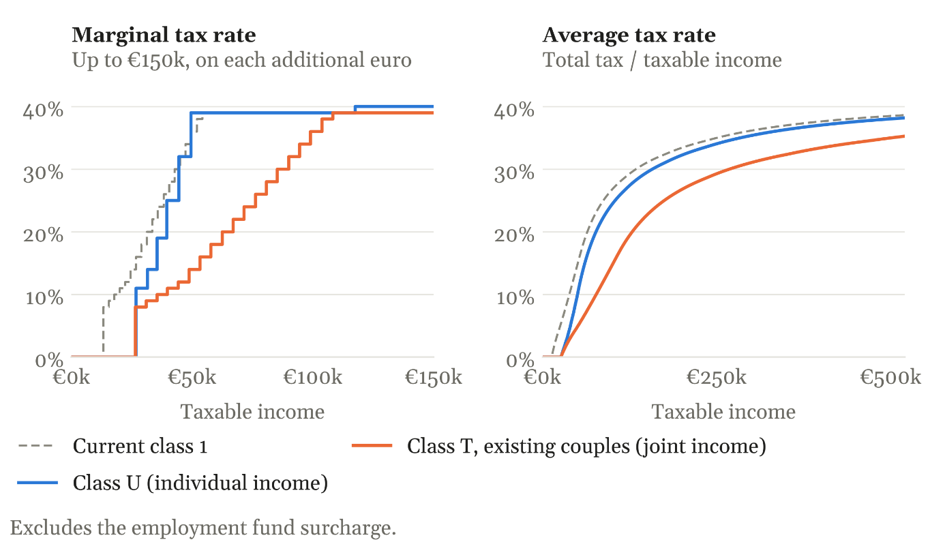
Tax class U provides for a tax-free bracket up to EUR 26,650, followed by progressive rates ranging from 11% to 42% (excluding the employment fund surcharge). The maximum rate applies to taxable income exceeding EUR 234,800. Compared with today’s class 1, the tax-free amount roughly doubles, while the progression is steeper above it.
A 25-year transition for existing couples
Spouses married before 1 January 2028 will in principle remain taxed jointly under tax class T until the end of 2052. Registered partners keep this option only upon a joint request, to be made every year through their tax return; failing a request for a single year ends joint taxation permanently. This only applies to couples already taxed in Luxembourg from 2028; couples moving to Luxembourg later will be taxed under tax class U.
Tax class T provides for a tax-free bracket up to EUR 26,460, followed by progressive rates from 8% to 42% (excluding the employment fund surcharge). The maximum rate applies to taxable income above EUR 469,740. In substance, it carries over the current class 2 unchanged.
Where one or both spouses are non-residents, joint taxation remains subject to specific income conditions and formalities. If these are not met, even for a single year, joint taxation may be lost permanently.
Eligible couples may instead opt for individual taxation under tax class U where more favourable. Any election is irrevocable and makes a tax return compulsory for both spouses, at least for the first year of individual taxation. It should therefore be carefully considered.
Accompanying measures
The reform is accompanied by several supporting measures:
- a new EUR 5,400 early-childhood allowance per child under three, available only under tax class U;
- an increase of the single-parent tax credit to EUR 4,008 for income below EUR 60,000, decreasing gradually to EUR 750 above EUR 105,000;
- higher deduction ceilings for interest and insurance premiums (from EUR 672 to EUR 900) and for home-savings contributions (EUR 900, or EUR 1,500 for taxpayers aged 18 to 40);
- a longer transition (five years instead of three) under tax class T for widowed and divorced taxpayers previously taxed jointly; and
- an automatic adjustment of the tax brackets after every four wage indexations.
From tax year 2028, the annual tax reconciliation (décompte annuel) is abolished. Employees will instead be able to request a tax assessment.
Who goes where in 2028
What taxpayers should consider
Although the reform applies from 2028, taxpayers should anticipate its impact now.
Existing married couples and registered partners should compare staying under tax class T with moving to tax class U. They should consider their respective incomes, deductions, children and any cross-border situation.
Married couples wishing to have tax class U on their 2028 tax card must submit a joint request by 30 November 2027. A request filed in December 2027 still triggers individual taxation for 2028, but tax class U will only appear on the tax card from 2029.
Looking ahead
Bill No. 8676 marks a significant shift in Luxembourg personal income taxation. While the reform aims to make taxation less dependent on marital status, its actual impact will vary for each household.
Our Luxembourg tax team can model the impact of tax class U versus tax class T for your household and assist with any election before 30 November 2027.